Wood-Burning Stove and Heater Manufacturer in Vietnam: OEM, Private Label and Custom Builds
Duy’s Oven is the workshop name of Cong ty Co phan Cong nghe Co khi Nong nghiep Harmonia, tax code 0315700830, on Le Van Luong road in Hiep Phuoc, Nha Be, Ho Chi Minh City. We have been cutting, welding and firing steel here since 2018. Most of what leaves the yard is charcoal cooking equipment for the Vietnamese market. This page is about the other bench: wood-burning heaters and stoves, and what it would take to build them for your brand.
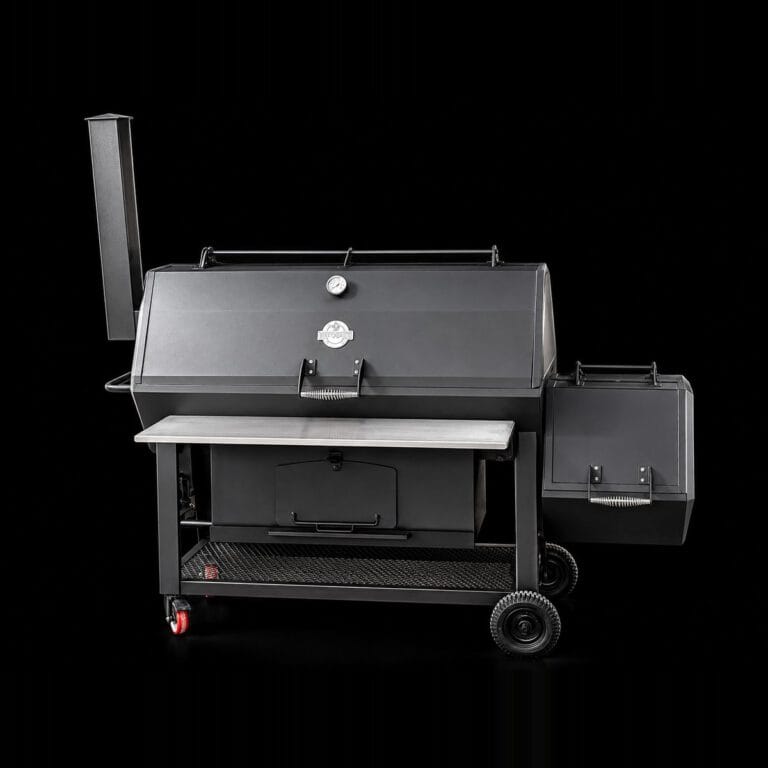
If grills are what you came for, that side is written up separately in Charcoal Grill and BBQ Equipment Manufacturer in Vietnam. Same welders, different appliance. One warning first: we are a workshop, not a certified stove factory. The certification section below is where that matters, and it is the part to read first.
What wood-burning heaters do you actually build?
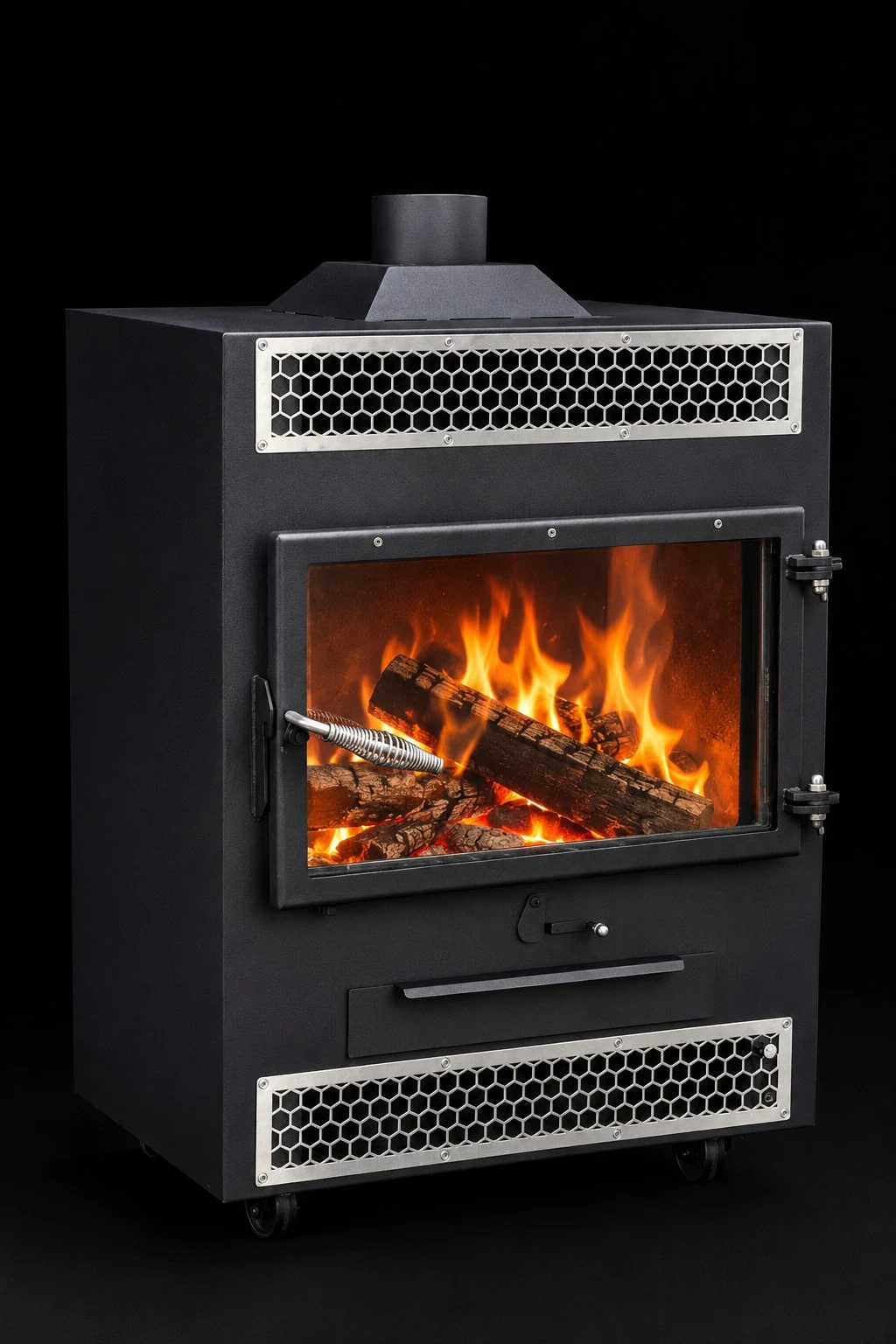
Four models are in production today: three room heaters in the FirePlace line, and one tall portable heater made for camping. Every dimension below is measured off the real product. What we have not measured, we leave blank instead of inventing it.
FirePlace Convection
The FirePlace Convection measures 60 × 55 × 110 cm. Double steel shell, 3 mm and 5 mm plate, with a convection air gap between the layers. It is the only model in the line with an electric part.
FirePlace Pizza
The FirePlace Pizza measures 50 × 45 × 110 cm and weighs about 85 kg. A wood-burning heater with a cooking chamber floored in 20 mm cordierite stone, a 150 mm flue standing 4.5 m with a rain cap, a heat-resistant glass door, a removable ash tray and a log store in the body.
FirePlace Basic Wood
The FirePlace Basic Wood measures 50 × 45 × 90 cm. Steel over 3 mm, tempered heat-resistant glass, heat-resistant paint rated to 650 °C, two heat settings. The plainest of the three, and the easiest to change for a customer.
Forester Rocket camping heater
The Forester Rocket measures 49 × 30 × 147 cm and weighs 7.4 kg. The top plate is 304 stainless steel, the body is finished in heat-resistant paint to a US 600 °C rating. It burns wood, offcuts or charcoal, boils water on top, and is carried to the camp site rather than installed.
What is the convection model doing differently?
It puts a second steel skin around the firebox and moves air through the gap between the 3 mm and the 5 mm plate. Radiant heat goes out through the glass; the gap feeds warm air into the room. The fan runs on a dimmer, so the owner can turn the air movement down and leave the fire alone.
That fan is a motor, and a motor is a compliance question. Voltage, plug type, cord, switch and the electrical marks your market expects are decisions we need in the first email, not at pre-shipment inspection. The other three models have no electrical parts at all.
Can one appliance heat a room and bake a pizza?
The FirePlace Pizza is our answer. Cordierite is the reason: 20 mm of stone under the food holds heat and gives the base a proper bake, which sheet steel will not do. The 150 mm flue and its 4.5 m stack are sized for draught, not decoration, and the rain cap assumes the chimney stands outdoors in weather.
If your project is an outdoor cooking product rather than a heating appliance, say so early. It changes the build, and it changes which rules apply.
Can you certify these for our market?
No. We hold no CE, no UKCA and no ISO certification. We have no EN 13240 or EN 16510 test report, no Ecodesign declaration, and no EPA certification for any of these heaters. Saying otherwise would waste your time and ours. Here is the map as we read it.
- European Union. A heater installed in a dwelling counts as a construction product. CE marking runs under the Construction Products Regulation, now Regulation (EU) 2024/3110, which replaced Regulation 305/2011 on 8 January 2026 with transitional provisions still running. It needs initial type testing by a notified laboratory, and EN 16510-2-1 has replaced EN 13240 as the test basis — the coexistence period for the old standard ended on 9 November 2025. Ecodesign rules for solid-fuel local space heaters have applied since 1 January 2022, and self-declaration there still needs real laboratory data. Regulation 2015/1185 does not apply to heaters specified for outdoor use only, or to sauna stoves.
- United Kingdom. CE marking on construction products has been accepted indefinitely since September 2024, so a CE file travels. Ecodesign applies to new stoves. Selling into a smoke control area needs a DEFRA-exempt appliance, a separate application and a separate list.
- United States. The EPA rules in 40 CFR Part 60 Subpart AAA catch the importer as well as the manufacturer, at 2.0 g/h on crib wood or 2.5 g/h on cordwood since 15 May 2020. Safety listing is a separate certificate, UL 1482 or UL 737, and without it installers and insurers refuse the job. The EPA states that outdoor fireplaces, fire pits, pizza ovens, chimineas and barbecues fall outside those rules. Read the remaining exemptions narrowly. Under 40 CFR 60.531 a camp stove means one intended for use in a tent or other temporary structure, which is not what our camping heater is, and a cook stove has to pass oven-volume and cooking-surface tests before it counts. Do not assume a tall portable heater qualifies.
- Australia and New Zealand. Domestic solid-fuel heaters are tested to AS/NZS 4012 and AS/NZS 4013, with a certificate of compliance per model. Definitions vary by state, so check yours.
Two conclusions follow. First, an indoor room heater under your brand cannot go on a shelf in the EU, the UK, the US, Australia or New Zealand on our paperwork today — there is no paperwork, no shortcut and no certificate we can buy. Second, the exemptions are drawn around outdoor and portable products, and that is where a workshop like ours can start work immediately.
Which side your build falls on we will not decide for you. It depends on how the product is designed, marketed and warranted in your market, and the American rules in particular look at exactly that. It is your compliance officer’s call. Tell us in the first message and we scope it in, instead of discovering it at the port. Even in the exempt categories there is work left: technical file, manual and warnings in the market’s language, traceable labelling, an EU responsible person under the General Product Safety Regulation since 13 December 2024, product liability cover.
If you do want an indoor model certified, it is a joint project with a bill attached. We build the prototype, fire it, change the firebox or the air control after the lab reports back, and build it again. We are ready for the metal side of that loop; who pays the laboratory gets agreed in writing first.
What can you change for our brand?
Most of it, because these are fabricated products, not castings out of a fixed mould. No tooling to amortise, no minimum run protecting a die.
- Dimensions — height, depth, firebox volume, leg or plinth style.
- Door and glass — opening size, hinge side, handle, glass shape.
- Flue — diameter, take-off position, stack height, cap.
- Finish — heat-resistant paint colour, stainless surfaces, texture.
- Fittings — ash tray, grate, log store, cooking surface, cordierite floor.
- Branding — your logo laser-cut or engraved into the steel, and a rating plate naming your company as manufacturer of record.
- Documents — manuals in your language. We already publish a bilingual wood-heater manual at duyoven.vn/hdsd-lo-suoi-cui, so you can see where we start from.
We cut our own parts on a laser bed that takes full 1250 × 2500 mm sheet, so your drawing becomes a part here, not at a subcontractor. That side of the shop is already described on the charcoal grill OEM page.
Have you shipped wood heaters to Europe or the United States?
To be straight with you: we have sent one-off orders overseas, but we have not run a container programme, and we have never run a private label programme for a foreign brand. You are not walking into a machine that already works. You are walking into a workshop that wants the first one.
The logistics facts are short. Both Cat Lai and Cai Mep are reachable by road from Nha Be. Heaters are heavy and glass breaks, so packing is a design job to work through with your freight forwarder. Rules of origin decide whether a trade agreement helps you, and they look at where the inputs come from — your customs broker’s territory, not ours, and we supply the material declarations they ask for.
How do you quote?
Per model, per drawing, per quantity. We publish no minimum order quantity and no export price list, and we do not promise a delivery date before we have seen what you want built. Send drawings or a sketch with sizes on it, tell us the market and the quantity, and you get a real answer instead of a brochure.
Frequently asked questions
Do you have CE or EN 13240 certification for your wood stoves?
No. We hold no CE, UKCA or ISO certification, no EN 13240 or EN 16510 test report and no Ecodesign declaration. If you need a stove that can be sold legally at retail in the EU tomorrow, buy from a certified European factory.
Are your wood heaters EPA certified for the United States?
No. None of our heaters holds an EPA certificate of compliance, and none is UL listed. The EPA rules reach importers as well as manufacturers, so this is a real barrier for an indoor room heater. Outdoor fireplaces, fire pits and pizza ovens sit outside those rules.
What are the sizes of your wood heaters?
FirePlace Convection: 60 × 55 × 110 cm. FirePlace Pizza: 50 × 45 × 110 cm, about 85 kg. FirePlace Basic Wood: 50 × 45 × 90 cm. Forester Rocket camping heater: 49 × 30 × 147 cm, 7.4 kg.
Do any of your models use electricity?
One does. The FirePlace Convection has a convection fan with a dimmer, so it contains a motor and needs a voltage, plug and electrical compliance decision for your market. The Pizza, the Basic Wood and the Forester Rocket have no electrical parts.
Can you build a wood stove to our own drawings?
Yes, and that is the work that suits us best. Send DXF, PDF or dimensioned sketches. We cut on our own laser and fire a prototype before any batch, because we find the problems with fire, not with renderings.
What is your minimum order quantity?
We do not publish one. Sheet-metal work has no mould to pay off, so the sensible quantity depends on your drawing and finish. Tell us the model and the number you have in mind, and we price it honestly.
Do you make tent stoves for camping?
No. Our camping product is the Forester Rocket, a 147 cm tall portable heater of 7.4 kg that burns wood or charcoal and boils water. We do not build the short horizontal stoves made to run inside a hot tent.
Do you also make charcoal grills and BBQ equipment?
Yes, and that is the larger half of the business: grills, smokers and custom builds, set out on our charcoal grill and BBQ OEM page.
The short version
- A steel workshop in Nha Be, Ho Chi Minh City, building fire equipment since 2018.
- Four wood-burning heaters in production: Convection, Pizza, Basic Wood, Forester Rocket.
- No CE, no UKCA, no ISO, no EN 13240 or EN 16510, no Ecodesign, no EPA. Nothing.
- So the indoor heaters are not ready for retail in the EU, UK, US, Australia or New Zealand under your brand, and nobody can shortcut that.
- What can start now: outdoor and portable products, custom builds to your drawing, prototypes and small runs.
- No container programme yet and no private label programme yet. Only one-off shipments overseas.
Contact
- Company: Cong ty Co phan Cong nghe Co khi Nong nghiep Harmonia (Duy’s Oven), tax code 0315700830, established 2018.
- Workshop: Le Van Luong, Hiep Phuoc, Nha Be, Ho Chi Minh City, Vietnam.
- Email: info@duyoven.com
- WhatsApp and phone: +84 901 691 717 (Nguyen Vinh Duy).
- Websites: duyoven.vn and duyoven.com.
- Hours: Vietnam time, GMT+7. English by email or WhatsApp. Visitors welcome, with notice.
Tell us the model, the market and the quantity in the first message. If the answer is that we cannot help you yet, we will say that too.