Smoke-Reducing Charcoal Grills and Smokers: Six Mechanisms, Explained
We build charcoal grills and smokers in a workshop in Nha Be, on the south edge of Ho Chi Minh City. Close to fifty models. Buyers usually open with “which one is the good one”, which is the wrong question. These ovens are not one design in six sizes. They are six different mechanisms, and each sends fat, heat and smoke down a different path.
So this is a mechanism map, not a catalogue: where the fat goes, where the heat comes from, what you gain and what you give up.
What is the difference between a smoke-reducing grill and a smoker?
A smoke-reducing grill keeps rendered fat away from live coals, so it makes less of the acrid smoke you get from an open charcoal grill. A smoker does the opposite on purpose: it burns wood slowly to make smoke, then holds that smoke around the meat for hours.
One is getting rid of a smell. The other is building a flavour. Both still smoke. As we put it on our 250L grill page: it still makes smoke, charcoal smoke and fat smoke, just far less of the harsh kind you get when the coals sit right under the meat.
Where does the harsh smoke actually come from?
Not from the charcoal. From the fat. Fat breaks down above roughly 200 °C and live charcoal runs far hotter, so a drip landing on the coals becomes a puff of dirty smoke that settles back onto the meat. Hong Kong’s Centre for Food Safety set out that route in Risk Assessment Studies Report No. 14 (2004), and its advice was blunt: keep the meat off direct flame, and keep fat from dripping onto the heat source. That second half is a hardware problem.
The figures come from Lee and colleagues, Food Chemistry 199 (2016): with the drippings removed, the sum of four polycyclic aromatic hydrocarbons fell 48 to 89 percent in their trials, and removing the smoke from the food cut it 41 to 74 percent. The main contributor, they concluded, was smoke from fat dripping onto the fire and burning incompletely. That was their laboratory rig, not our ovens. We have never had our grills tested for this.
There is honest evidence on the other side, and it is closer to home than we would like. Sumer and Oz, Foods 12(7):1374 (2023), cooked beef with the heat source in a separate compartment, the smoke kept off the food and the fat kept off the coals — the same idea our ovens are built on — and found no statistically significant difference in total PAH4 or PAH8 against direct barbecuing (p > 0.05). We report it because it is the strongest published test of the principle we sell, and it did not come out our way.
Six mechanisms, and what each one trades away
1. Twin charcoal troughs, food over the gap
Two charcoal troughs sit low with the food between them, and the cooking grate rides high, near the mouth. Heat comes sideways from both fires, and rendered fat falls into the channel between them, into a tray, not onto coals. You get a permanent version of the two-zone fire good grillers build by hand, but no char from directly below, and two fires to feed instead of one. Suits fatty cuts that flare on an open grill: pork belly, chicken quarters, skewers.
2. Three levels with a water pan in the middle
Charcoal at the bottom, a water pan above it, one grate on top. The pan catches every drip and buffers the heat, while the water steams and keeps the meat from drying. The American barbecue world calls this a water smoker. Gentle, forgiving heat, but little searing power, and you top the pan up on long cooks. Suits whole chicken, ribs and shoulder cuts.
3. A V-channel grate that lifts out
A deflector folded into V ridges sits between fire and food. Fat lands on it, runs down the slope and out to both sides into a trough, and after service the deflector lifts out and goes in the sink. Easy cleaning, and small enough for a portable oven, at the cost of some radiant heat. Some models let you pull it out and grill straight over the coals.
4. Two grate levels, two heat zones
The lower grate sits close to the coals and sears. The upper sits well above it and holds or cooks slowly. A vent in the lid and a variable-speed fan set the draft, so the bottom runs hard while the top idles. Two jobs at once during service, but somebody has to keep moving food.
5. An offset firebox
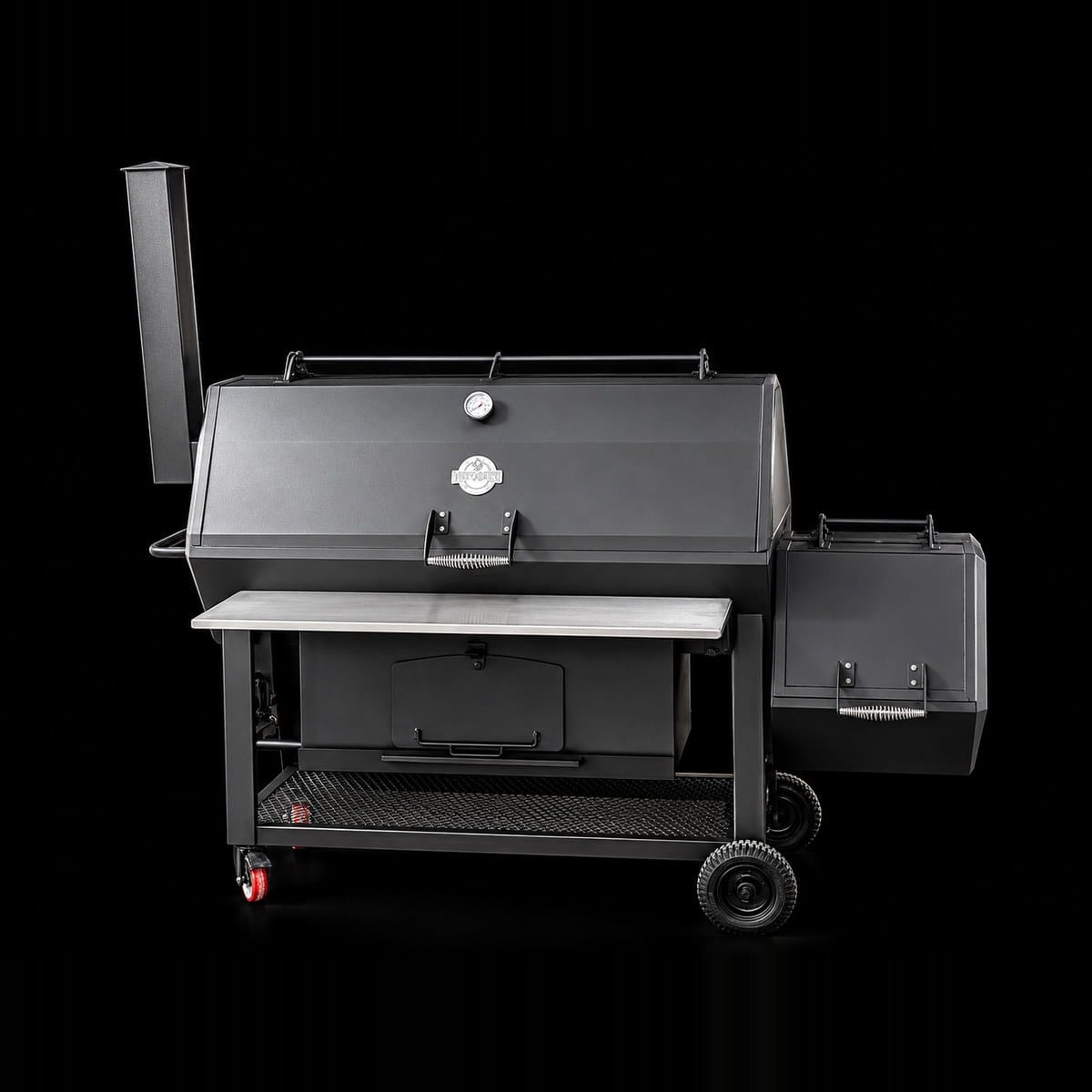
The fire lives in its own box on the side. Heat and smoke cross the cooking chamber and leave through a stack at the far end, so food never sits over flame and drips land on steel. Real wood smoke and a chamber you can hold low for hours, in exchange for feeding the fire every 45 to 60 minutes and learning the gradient, since the end near the firebox runs hotter. Suits brisket, beef ribs and sausage. Start here: offset smoker brisket for beginners.
6. Hybrid: one body, two ways of running it
Hybrid on our labels does not mean two fuels. As our Hybrid 125L page puts it, you change how you run the oven, not what you burn. Open it up for a hot fast cook; shut it down, cut the air, add wood, and the same body works low and slow. Two styles from one footprint, though a dedicated offset will still out-smoke it. Every Hybrid we build runs charcoal or wood. Our one gas-fired oven is the Gas Smoker.
Which mechanism is in which model?
Smoke-Reducing 65L, 80L and 125L
These three run mechanism 1 and differ in throughput. The 65L is 60 × 40 × 155 cm, 45 kg, one grate level, 2 to 3 kg of meat in roughly 45 minutes at 200 to 250 °C. The 80L is 110 × 60 × 175 cm, 70 kg, two grate levels, 4 to 5 kg in 45 to 60 minutes. The 125L is 126 × 65 × 175 cm, 90 kg, two grate levels, 8 to 10 kg in 60 to 90 minutes.
125L Pro
The 125L Pro shares the 126 × 65 × 175 cm shell and 90 kg weight of the standard 125L and adds mechanism 4 to the same smoke-reducing layout: two grate levels worked as separate heat zones, a vent on the lid, a 12 V blower with a dial. Ships with a clamp grate, an H-grate and a lifter.
Smoke-Reducing 85L
The 85L is our water-pan oven, mechanism 2: coals underneath, water pan in the middle, one stainless grate of 39 × 74 cm on top. It is 85 × 50 × 100 cm, 85 litres, with a 45 cm stack, a folding 20 cm side shelf and wheels.
Pantina folding grill
The Pantina is our V-channel oven, mechanism 3. The V grate sheds fat to both sides and lifts out for washing, the fan is variable speed, the legs fold. One load is about three chickens. Do not confuse it with the Pantina Smoker below: same family name, different machine.
Hybrid Polygon
The Hybrid Polygon is mechanism 5 in a faceted body: a separate firebox of 45 × 45 cm with its own grease drain, smoke crossing the chamber indirectly, a vent on the faceted face, a chimney cap, a fan for draft. Two levels of expanded metal mesh grate, not stainless. Around 70 kg. Burns wood or charcoal.
Hybrid 125L
The Hybrid 125L is mechanism 6: 130 × 58 × 110 cm, 93 kg, 125 litres, stainless grate, wheels, smoke ducted out through a stack instead of washing over the cook. Charcoal or wood, never gas. A different oven from the standard 125L and the 125L Pro, so ask for it by name.
Offset Smoker 10050 and Offset Smoker 15070
The Offset 10050 has a chamber 100 cm long and 50 cm in diameter, a firebox of 40 × 45 cm, two levels of stainless grate, about 100 kg, and an insulated section on the stack that holds convection steadier on windy days. Texas-style running sits near 107 to 135 °C for a 6 to 18 hour cook. The Offset 15070 is the commercial version: a 150 × 70 cm chamber taking 30 to 50 kg per load, a firebox with two doors so fuel goes in one and ash out the other mid-cook, four removable grates across two levels, an air door and a stack valve to set how heavy the smoke runs. The 10050 is built offset or reverse to order, so say which you want.
Pantina Smoker
The Pantina Smoker is a folding offset of 17.5 kg that packs to 75 × 30 × 40 cm and stands at 78 × 30 × 82 cm. Firebox 20 × 23 × 25 cm, smoke chamber 50 × 30 × 35 cm, two stainless grates of 255 × 245 mm, maximum load 4 kg. The word SMOKERY cut through the body is the air intake. Built to smoke, not to grill: 110 to 135 °C, wood every 45 to 60 minutes.
SubMarine Mini
The SubMarine Mini is not an offset. Charcoal and smoking wood share one barrel chamber, charcoal doing heat and wood doing smoke, with thick steel holding temperature instead of a separate firebox. Overall 250 × 50 × 130 cm, two grate levels.
Gas Smoker
The Gas Smoker is our one gas-fired oven, and it splits the two jobs: gas heats the chamber and holds it for hours with nobody raking ash, while a separate box of wood and charcoal supplies the smoke. 210 × 80 × 130 cm, 140 kg. It exists for smoke houses that open seven days a week.
Which one should you be asking about?
- A restaurant grill running all shift. The 125L Pro, or the twin-chamber 180 × 60, mechanism 1 doubled into two independent chambers. More in our commercial charcoal oven guide.
- A yard or terrace with neighbours close by. The 65L or the 85L, since keeping fat off the coals changes what drifts next door. On an apartment balcony, read balcony charcoal grilling with less smoke first and check your building rules, since many places prohibit charcoal outright.
- Camping and travel. The Pantina folding grill to cook, the Pantina Smoker to smoke. Both fold into a car boot.
- Brisket, beef ribs, low and slow. Offset 10050 for a household that cooks seriously, Offset 15070 when staff have to run it.
- A grill house or rice-plate kitchen. The trough ovens sized to your batch: 65L, 80L or 125L. Ask us for kilos per hour, not litres.
Frequently asked questions
Do these grills eliminate smoke?
No. Charcoal makes smoke and fat makes smoke. What the design changes is how much fat reaches live coals, which is where the harsh smoke comes from. Anyone promising a charcoal grill that makes none is selling a word, not a mechanism.
Why does my charcoal grill smoke so much?
Three usual causes: fat dripping onto the coals, not enough air so the fuel smoulders and burns incompletely, and sugary marinade burning on the grate. The first is hardware. The other two are technique.
Do all your models work the same way?
No. Six mechanisms run through the range: twin charcoal troughs, a water-pan stack, a removable V-channel grate, zoned grate levels, an offset firebox, and a hybrid body that grills open and smokes closed.
Is the Hybrid a gas grill?
No. Every Hybrid we build runs charcoal or wood. Hybrid means running one oven two ways, grilling and smoking, not two fuels. The one gas oven in our range is the Gas Smoker.
Do the grills need electricity?
Some do, for the air fan alone: 12 V DC 2 A or a Type-C power bank, which we do not supply. The offset smokers and the Pantina Smoker are drafted by hand, through the air intake and the stack valve.
Do you have CE, UKCA or ISO certification?
No. We hold none of them, and no oven of ours has been tested to an emissions or food-contact standard. If your market requires it, that testing has to happen and we will work with you on it.
Can you build these to our drawing?
Yes. We cut our own sheet in-house on a laser that takes plates up to 1250 × 2500 mm, we work from DXF, and we prototype in steel rather than in renderings. Grate spacing, chamber length, vent position and shelves are normal changes.
What is your minimum order quantity?
We do not publish one. We will build a single sample so you can burn it, cook on it and take it apart, with freight at your cost. Better you argue with a real oven than with a PDF.
The short version
Fat landing on live coals is what makes barbecue smoke harsh. Six mechanisms attack that in six ways, and picking the wrong one is how people end up disappointed by a well-built oven. Both families still smoke. Match the mechanism to the food and to the shift you run, not to the litre count on the label.
Build these under your own brand
Harmonia Agricultural Mechanical Technology JSC, trading as Duy’s Oven, has been fabricating in Nha Be since 2018. We do OEM to drawing, with our own laser cutting, welding and finishing. We have not yet run a container programme or a private label line for a foreign brand, only individual export orders, so if you need a supplier with that history on the wall, we are not it yet. We hold no CE, UKCA, ISO or EPA certification. Buyers are welcome to visit and watch their parts being cut. Two pages cover the terms: charcoal grill manufacturer in Vietnam for the barbecue range, and wood burning stove manufacturer in Vietnam for the heating range. Cat Lai and Cai Mep are both a road haul from our gate.
Contact
- Email. info@duyoven.com
- WhatsApp and phone. +84 901 691 717, Nguyen Vinh Duy
- Websites. duyoven.com in English, duyoven.vn in Vietnamese
- Workshop. Le Van Luong, Hiep Phuoc, Nha Be, Ho Chi Minh City, Vietnam, GMT+7
- More reading. Our English library, the BBQ Academy